VERIFITECH – Background Verification Company

Global Redirect Menu

Others

Others

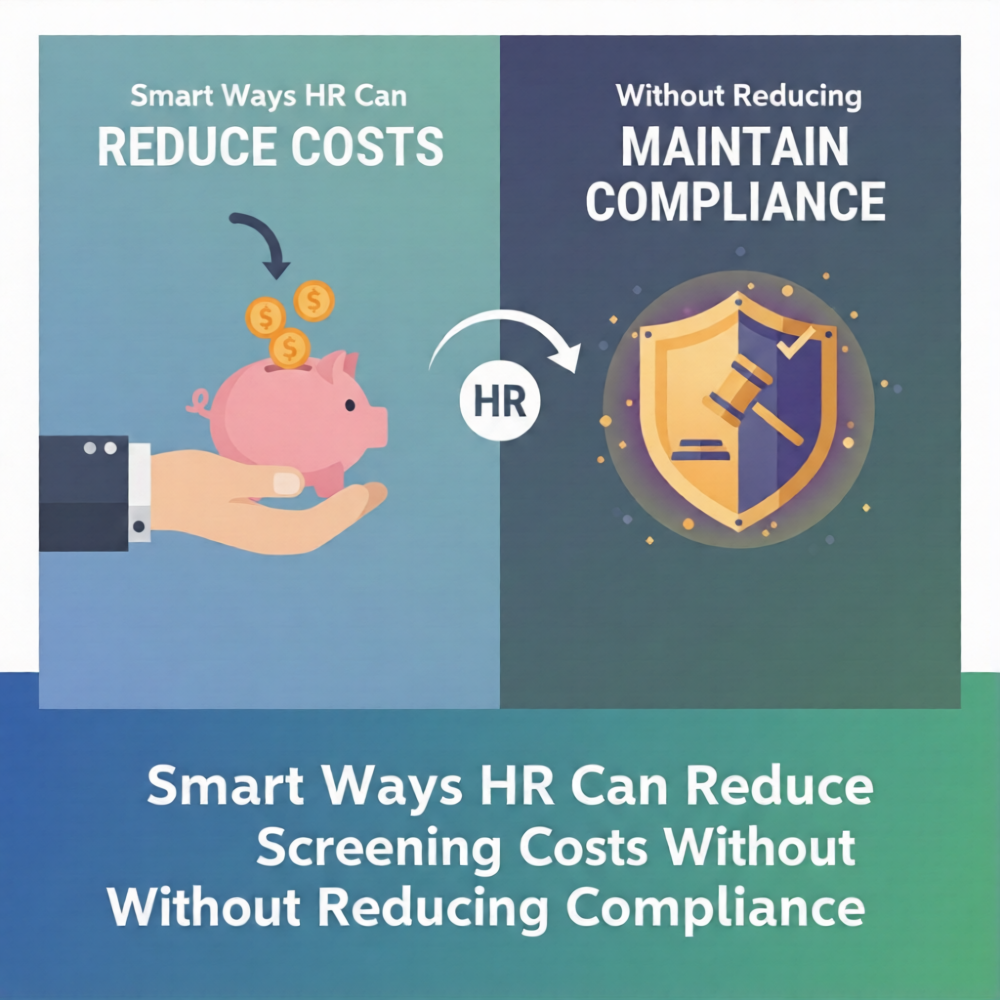
Smart Ways HR Can Reduce Screening Costs Without Reducing Compliance

Smart Ways HR Can Reduce Screening Costs Without Reducing Compliance:    It’s 6:30 p.m., and you’re still at your desk. The hiring numbers look good—but your budget doesn’t. Background verification expenses are climbing, finance is asking tough questions, and compliance risks keep you up at night. You want faster hiring, safer onboarding, and cost-effective background checks—but without cutting corners. Sound familiar? For many HR leaders, the tension between speed, safety, and spending feels constant. One wrong hire can cost far more than a screening program ever will. Yet overspending on unnecessary checks drains resources that could be invested elsewhere. The real challenge isn’t choosing between cost and compliance. It’s finding smarter ways to balance both. Because when screening costs spiral—or compliance slips—your entire organization feels the impact. For many HR leaders, the tension between speed, safety, and spending feels constant. One wrong hire can cost far more than a screening program ever will. Yet overspending on unnecessary checks drains resources that could be invested elsewhere. The real challenge isn’t choosing between cost and compliance. It’s finding smarter ways to balance both. Because when screening costs spiral or compliance slips —your entire organization feels the impact. Detailed Issue Exploration: Let’s start with a truth most HR professionals quietly acknowledge: background screening costs don’t rise overnight. They creep up. A new role requires an additional check.A vendor adds a premium service.A last-minute compliance requirement forces urgent processing fees. Before you know it, your screening line item has ballooned—without a clear strategy behind it. Why Screening Costs Get Out of Control One of the biggest reasons organizations struggle with screening cost reduction is over-standardization. Many companies apply the same screening package to every employee—interns, executives, contract staff, and remote freelancers alike. It feels safe. It feels consistent.But it isn’t always smart. Not every role carries the same level of risk. Screening a warehouse associate should not cost the same as screening a CFO. Yet many HR teams use blanket policies because they’re easier to manage. Another factor? Reactive compliance. Instead of proactively designing compliance-friendly checks aligned with regulations, some teams add layers of verification after audits or incidents. This “add-on culture” creates complexity and cost. Then there’s vendor fragmentation. Working with multiple background verification providers often leads to duplicate checks, inconsistent pricing, and hidden administrative expenses. Without centralized oversight, HR budget optimization becomes nearly impossible. The Real Cost of Cutting Corners When budgets tighten, the temptation is obvious: reduce checks, choose the cheapest vendor, or eliminate certain screenings. But here’s the problem. A single negligent hire can cost far more than your annual verification budget. Legal penalties. Reputational damage. Productivity loss. Internal disruption. Suddenly, what looked like savings becomes a liability. That’s why the goal isn’t just screening cost reduction. It’s smarter spending. The smartest HR leaders focus on cost-effective background checks that protect the organization while preserving financial health. So how do you actually do that? 1. Implement Role-Based Screening Tiers This is one of the simplest and most powerful strategies. Create screening tiers based on job risk levels: Low-risk roles: Basic identity, address, and criminal verification. Medium-risk roles: Add employment and education verification. High-risk roles: Include financial checks, global database searches, or regulatory screenings. By aligning verification depth with job risk, you immediately control unnecessary expenses while maintaining compliance-friendly checks tailored to the role. This structured approach also strengthens documentation. If regulators ever ask why certain checks were conducted, your policy clearly shows risk-based reasoning. That’s compliance and HR budget optimization working together. 2. Audit Your Current Screening Stack When was the last time you reviewed your screening package? Many organizations continue paying for services they no longer need. Outdated checks. Duplicate reports. Premium turnaround times for non-urgent hires. Conduct a quarterly review: Which checks are legally required? Which are role-specific? Which are “just in case”? Eliminating redundancy doesn’t weaken compliance. It strengthens clarity. And clarity leads to better screening cost reduction decisions. 3. Consolidate Vendors for Efficiency Working with a single reliable screening partner often reduces administrative costs, improves data consistency, and enables negotiated pricing. Bulk hiring? Volume discounts.Seasonal recruitment? Flexible packages. Vendor consolidation is one of the fastest paths to cost-effective background checks without sacrificing quality. More importantly, centralized tracking improves reporting—making compliance-friendly checks easier to document and defend. 4. Automate Where Possible Manual verification processes drain both time and money. Automated workflows reduce back-and-forth communication, accelerate turnaround times, and minimize human error. Faster processing doesn’t just improve candidate experience—it also reduces hidden operational costs. Automation also supports HR budget optimization by giving you data visibility. You can track: Cost per hire Turnaround times Re-screening frequency Vendor performance Data-driven HR teams don’t guess. They adjust strategically. 5. Avoid Over-Screening Through Policy Clarity Sometimes the issue isn’t vendors—it’s unclear internal policy. If hiring managers request additional checks “just to be safe,” costs will spiral. Establish clear approval processes for additional screenings. Define: What’s mandatory What’s optional Who approves exceptions This ensures screening cost reduction happens systematically—not accidentally. 6. Stay Proactive About Regulatory Changes Compliance isn’t static. Regulations evolve. Instead of reacting to penalties or audit findings, assign responsibility for monitoring legal updates related to employment screening. A proactive approach prevents last-minute compliance expenses. When your checks are intentionally designed to be compliance-friendly checks from the start, you avoid costly rework. And that’s where real HR budget optimization happens. 7. Measure ROI—Not Just Cost Here’s a mindset shift: don’t only track what you spend. Track what you prevent. How many hires were flagged due to discrepancies?How many risks were identified before onboarding? When you connect screening outcomes to business protection, cost-effective background checks become an investment—not an expense. This perspective changes internal conversations. Instead of defending spending, you demonstrate value. Building a Sustainable Strategy Smart HR leaders understand something crucial: screening cost reduction is not about reducing safety. It’s about reducing inefficiency. It’s about asking: Are we screening smartly? Are we aligning checks with risk? Are we leveraging data? Are we negotiating strategically? When your screening program is intentional, structured,
Others

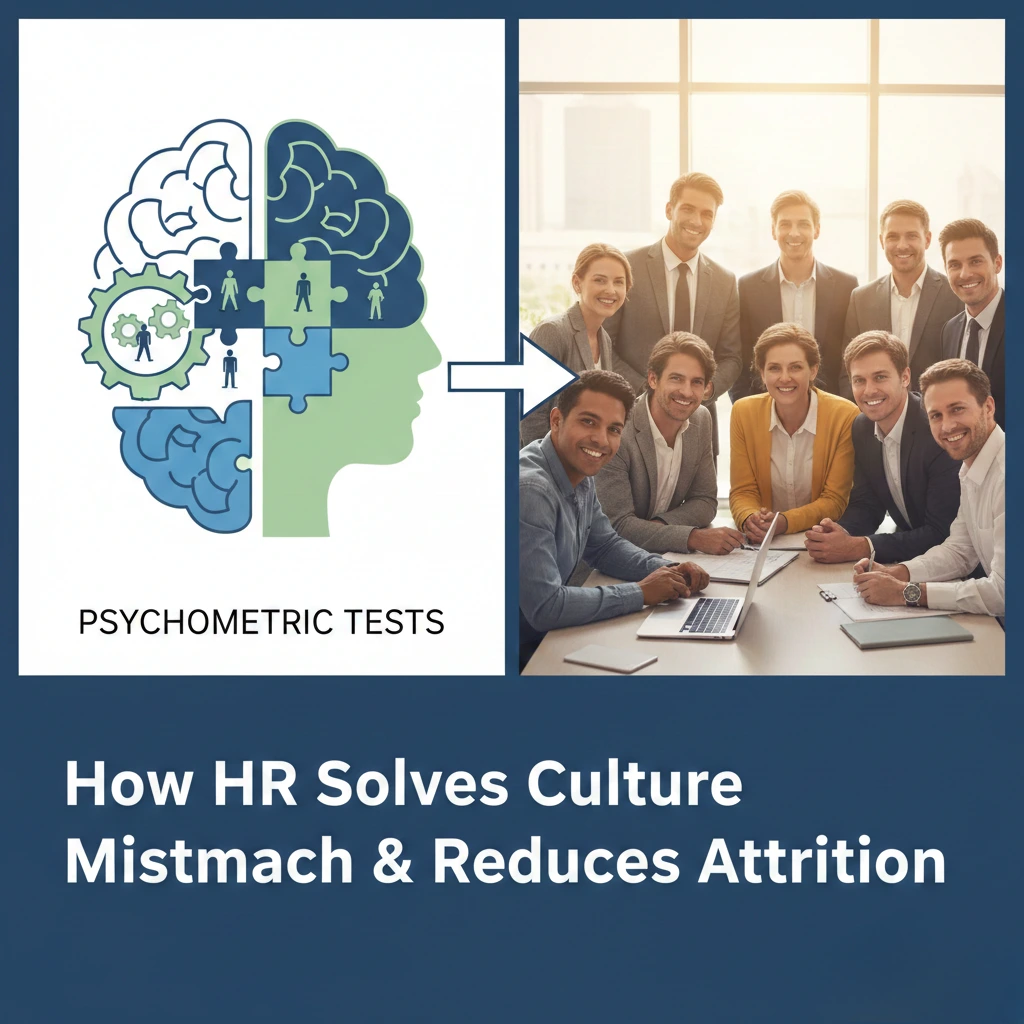
How Psychometric Tests Help HR Solve Culture Mismatch & Reduce Attrition

How Psychometric Tests Help HR Solve Culture Mismatch & Reduce Attrition   You hire someone who looks perfect on paper. Great resume. Solid interview. Impressive references.Three months later, they’re disengaged. Six months later, they resign. Sound familiar? For many HR leaders, this isn’t a one-off problem—it’s a pattern. The real issue often isn’t skill gaps or compensation. It’s culture mismatch. When employees don’t align with how your organization thinks, works, and behaves, performance drops and attrition rises. Traditional hiring methods rarely uncover this risk. That’s where psychometric assessment, culture fit hiring, employee behavior analysis, and predictive hiring tools are quietly changing the game. These tools help you see beyond resumes and interviews—into how people actually behave, adapt, and thrive at work. And in today’s high-attrition market, that insight matters more than ever. Why culture mismatch is costing you more than you realize Culture mismatch isn’t always loud. It doesn’t show up as immediate conflict or poor performance reviews. Instead, it appears subtly—missed collaboration, resistance to feedback, lack of ownership, or quiet disengagement. An employee may be competent, even talented, but if their values, working style, or decision-making approach clashes with your organization’s culture, friction is inevitable. Over time, that friction turns into burnout, poor morale, and eventually attrition. The hidden cost?Recruitment expenses. Training time. Team disruption. Lost productivity. Employer brand damage. This is exactly why many HR teams are rethinking how they define “the right hire.” The limitation of resumes and interviews Resumes tell you what someone has done.Interviews tell you what someone says they’ll do. Neither reliably tells you how someone behaves under pressure, responds to authority, collaborates with peers, or adapts to change. Interviews are especially vulnerable to bias—conscious and unconscious. Candidates present their best selves. Hiring managers rely on gut feel. Culture fit becomes a vague judgment rather than a measurable insight. This is where psychometric assessment, culture fit hiring, employee behavior analysis, and predictive hiring tools offer a structured, objective alternative. What psychometric tests actually measure (and why it matters) Psychometric tests are not about intelligence alone. Modern assessments focus on behavioral tendencies, personality traits, emotional intelligence, motivation, and work preferences. They help answer questions like: Does this person thrive in structured or flexible environments? Are they naturally collaborative or independent? How do they respond to stress, conflict, or ambiguity? What motivates them—recognition, stability, autonomy, growth? When used correctly, employee behavior analysis reveals patterns that interviews simply can’t uncover. For example, a fast-growing startup may need employees who are comfortable with ambiguity and rapid change. A highly regulated industry may require individuals who value structure, compliance, and consistency. Hiring against these realities—without realizing it—is a recipe for early exits. Culture fit hiring without the bias Culture fit hiring often gets misunderstood. It’s not about hiring people who “look like us” or “think like us.” That approach leads to homogeneity and limits innovation. True culture fit is about alignment with values, behaviors, and ways of working—not personality cloning. Psychometric tools help HR teams define culture objectively. Instead of vague labels like “team player” or “self-starter,” you get measurable traits and behavioral indicators. This clarity reduces bias and supports fairer, more inclusive hiring decisions. In the middle of the hiring journey, psychometric assessment, culture fit hiring, employee behavior analysis, and predictive hiring tools act as a reality check—confirming whether a candidate’s natural tendencies align with your actual work environment. Predicting attrition before it happens One of the biggest advantages of psychometric testing is its predictive power. By analyzing behavioral data across high-performing, long-tenured employees, organizations can identify patterns linked to success and retention. These insights then feed into predictive hiring tools, helping HR anticipate which candidates are more likely to stay, grow, and perform. For instance: A role with high customer interaction may require emotional resilience and patience. A leadership role may demand assertiveness combined with empathy. A sales role may succeed with competitiveness balanced by adaptability. When candidates lack these core behavioral drivers, the risk of disengagement—and eventual attrition—rises sharply. Real-world impact: from reactive to strategic HR Organizations that integrate psychometric testing early in hiring report measurable outcomes: Lower early-stage attrition Faster onboarding and role adjustment Improved team dynamics Stronger leadership pipelines HR teams move from reactive hiring—constantly replacing leavers—to strategic workforce planning. Decisions are backed by data, not just intuition. Most importantly, employees feel understood. When people join roles that align with how they naturally think and work, engagement increases. And engaged employees don’t leave easily. Making psychometric tools work for you Psychometric tests aren’t magic bullets. Their value lies in how they’re used. Best practices include: Combining assessments with structured interviews Using them as decision support, not decision replacement Aligning test frameworks with your actual organizational culture Communicating results transparently with candidates When implemented thoughtfully, psychometric assessment, culture fit hiring, employee behavior analysis, and predictive hiring tools become a long-term investment in people—not just a hiring filter. Conclusion:  Skills can be trained. Culture alignment is harder to fix. In a competitive talent market, reducing attrition isn’t about hiring faster—it’s about hiring smarter. By understanding how candidates think, behave, and adapt, HR teams can prevent costly mismatches before they happen. That’s why psychometric assessment, culture fit hiring, employee behavior analysis, and predictive hiring tools are no longer “nice to have.” They’re essential for building teams that stay, grow, and perform.  

Others

How HR Can Reduce Background Check Delays Using Automation & API Tools

  You’ve finally found the perfect candidate. The offer is accepted. The joining date is locked. Then comes the silence.   Days pass. Follow-ups pile up. The hiring manager grows impatient. The candidate starts exploring other offers—all because the background check is stuck somewhere in the process. If this sounds familiar, you’re not alone. For many HR teams, delays in verification are the biggest bottleneck in hiring. Manual follow-ups, disconnected vendors, and outdated workflows quietly derail even the best recruitment plans.  In today’s talent-driven market, fast background checks, screening automation, API verification, reduce TAT, HR efficiency are no longer “nice to have”—they’re critical. Because when background checks slow you down, they don’t just delay onboarding. They cost trust, talent, and time. Let’s talk honestly about why background checks take so long. In most organizations, verification still runs on emails, spreadsheets, PDFs, and human follow-ups. HR teams send documents to vendors. Vendors manually validate data. Status updates come late—or not at all. Every missing detail restarts the clock. The result? TAT stretches from days into weeks. And here’s the uncomfortable truth: candidates don’t wait anymore. A delay of even 3–5 days can be the difference between a successful hire and a dropout. This is where fast background checks, screening automation, API verification, reduce TAT, HR efficiency start becoming strategic priorities rather than operational concerns. The Real Causes Behind Background Check Delays First, manual dependency.  Every manual step—emailing documents, verifying IDs, coordinating with multiple agencies—introduces friction. One missed follow-up can stall the entire process. Second, lack of system integration.  HRMS, ATS, and background verification platforms often operate in silos. Recruiters update one system. Vendors work in another. There’s no real-time visibility. Third, inconsistent data quality. Incomplete candidate information leads to rework. HR teams chase candidates. Vendors pause checks. TAT quietly increases. Fourth, volume pressure. During bulk hiring or seasonal recruitment, manual processes simply don’t scale. HR teams burn out. Accuracy drops. All of this directly impacts HR efficiency, even though the root problem isn’t effort—it’s process design. The Hidden Cost of Delayed Verification Delayed background checks don’t just slow hiring. They affect the business in deeper ways. Candidates lose confidence in your organization Offer-to-join ratios drop Recruiters spend more time tracking than hiring Hiring managers lose trust in HR timelines Compliance risks increase under pressure to “speed things up” When leadership asks HR to reduce TAT, the answer isn’t working longer hours. It’s changing how verification works. This is exactly where screening automation enters the picture. How Screening Automation Changes the Game Screening automation removes repetitive, manual tasks from the verification lifecycle. Instead of chasing emails, systems trigger actions automatically: Candidates receive instant verification requests Documents are validated digitally Status updates sync in real time Exceptions are flagged immediately What once took days now takes hours. Automation ensures consistency. No steps are skipped. No follow-ups are forgotten. And HR teams finally regain control over timelines. This is why organizations that adopt fast background checks, screening automation, API verification, reduce TAT, HR efficiency see immediate improvements—not just in speed, but in accuracy and candidate experience.   The Power of API Verification Automation alone is powerful. But APIs are what truly accelerate verification. API verification allows background check platforms to integrate directly with: Government databases Education institutions Employment records Global watchlists Criminal databases Instead of manual verification, data is fetched securely and instantly. Think of it this way:APIs remove human waiting time from the process. For HR teams, this means: Real-time verification status Predictable turnaround times Fewer manual escalations Seamless ATS and HRMS integration When APIs are embedded into your hiring workflow, background checks stop being a “separate process.” They become part of hiring itself.  And that’s how organizations truly reduce TAT. A Real-World Hiring Scenario Consider a fast-growing IT company hiring 50 developers in 30 days. Earlier: Manual document collection Vendor follow-ups Average TAT: 7–10 working days Dropouts due to delays After implementing screening automation with API verification: Candidate self-service portals Automated document validation Real-time dashboards for HR Average TAT: 24–48 hours The hiring team didn’t grow. The pressure didn’t increase. The process simply became smarter. That’s the real promise of fast background checks, screening automation, API verification, reduce TAT, HR efficiency—doing more without burning out your HR team. What HR Leaders Should Focus On If you’re evaluating automation, focus on:   End-to-end digital workflows API-ready verification partners Real-time reporting and alerts Data security and compliance Candidate-friendly experience  Automation should simplify your work, not complicate it. When done right, HR shifts from “tracking status” to “driving hiring outcomes.”   Conclusion: Faster Checks, Smarter Hiring In a competitive talent market, speed is trust. And trust wins hires.   Background verification delays are no longer just operational issues—they’re strategic risks. By embracing fast background checks, screening automation, API verification, reduce TAT, HR efficiency, HR teams can transform verification from a bottleneck into a competitive advantage.   The future of hiring isn’t about working harder.  It’s about building systems that work faster—for you and your candidates.   And the faster you adapt, the faster your best talent joins you.

Others

The Hidden Risks HR Faces When Background Checks Are Skipped:

The Hidden Risks HR Faces When Background Checks Are Skipped:        Imagine this: You hire someone who seems perfect on paperconfident, experienced, and exactly what your fast-moving team needs. A few months later, unexpected issues begin to surface. A mismanaged project, a complaint from a client, or a sudden drop in team morale. You dig a little deeper, only to discover that the employee had a history no one checked—something that a simple verification would have revealed. This is where the background check importance, HR challenges, employee fraud conversation becomes more real than theoretical. HR professionals are continually encouraged to employ swiftly, keep prices down, and fill pressing skill gaps. However, ignoring background checks in a hurry might have much more serious and expensive repercussions. And these consequences rarely stay hidden for long. Why Skipping Background Checks Is More Common Than You Think   Many HR teams assume that “gut feeling,” strong communication skills, or referrals are enough to validate a candidate’s trustworthiness. In reality, recruiting without due diligence has quietly become one of the major HR concerns in today’s competitive climate. Sometimes the hiring manager is adamant about “closing the position tomorrow,” or deadlines are pressing, so the skip is deliberate. Sometimes it’s inadvertent—for example, the company doesn’t yet have a formal background check procedure, or HR is handling ten things at once and verification gets overlooked. But regardless of the rationale, the risk remains the same: you’re making decisions in the dark.  The Invisible Cost of a Bad Hire   A bad hire doesn’t just disrupt workflow—it ripples into multiple layers of the business. Industry statistics state that bad hiring choices can cost businesses up to 30% of an employee’s yearly compensation. That includes productivity loss, rehiring fees, retraining expenses, and potential legal difficulties. The repercussions increase when employee fraud is involved. Fraudulent personnel may function silently for months, even years, before the organisation detects the red signals. Fake educational certificates, forged experience letters, undisclosed criminal history—these are ticking time bombs that explode when the company least expects it. This is exactly where the background check importance becomes evident—not just as a compliance formality but as a strategic shield. Real-World Scenarios HR Teams Face   Consider a tech company that hired a “senior developer” after a quick interview loop. Once onboarded, the employee struggled with basic tasks. Only later did the company realize that the experience certificate he provided was entirely fabricated. Or take the HR executive who hired a finance manager without verification due to urgent hiring pressure. Within six months, internal audits revealed misappropriation of funds—classic employee fraud that could have been prevented. These examples aren’t rare—they happen in organizations of all sizes. And in most cases, HR ends up absorbing the blame, even though the root cause is simply a missing screening process. Reputational Damage: The Silent Killer   Beyond financial or operational damage lies the biggest threat: your company’s reputation. One bad hire with a questionable record can easily become a PR nightmare.Imagine an employee with a concealed criminal background managing critical client data. One complaint or event can damage client confidence, impact long-term business relationships, and even lead to contract losses. This makes skipping verification not just an HR oversight—it becomes a business risk. Compliance Risks You Shouldn’t Ignore   Industries like IT, healthcare, fintech, and logistics have strict compliance requirements. Failing to verify a candidate’s identity, qualifications, or criminal record can lead to legal liabilities. In severe instances, organisations face regulatory penalties for permitting unverified persons to handle key information or operations. These compliance gaps are one of the growing HR challenges companies struggle with. HR teams must now balance speed, quality, and compliance—three elements that rarely coexist without structured background screening. Why Employees Sometimes Lie—And How Screening Protects You   It’s uncomfortable but true: candidates lie. Sometimes it’s small—adjusting job dates, exaggerating skills. In other circumstances, it’s important—false IDs, police clearance certificates, bogus experiences, or concealing continuing criminal cases. A comprehensive background check throws a light on these disparities before they evolve into workplace calamities.It ensures: Identity verification Education and credential validation Past employment confirmation Criminal and legal checks Address verification Every layer strengthens your hiring process and filters out risks that are invisible during interviews. Addressing the Speed vs. Accuracy Dilemma   One common argument HR teams make is, “Background checks slow down hiring.”But modern verification tools and agencies have dramatically changed that. Today, checks can be completed within 24–72 hours, even for complex verifications. This means no more compromising speed for safety. In fact, integrating screening into the hiring workflow actually saves time—because you avoid rework, rehiring, and damage control caused by poor selections. When viewed through this lens, the background check importance is undeniable. How HR Can Strengthen Their Hiring Process   To reduce the risk of employee fraud and other costly consequences, HR teams should: Make background screening mandatory for all roles, not just senior positions. Create a standardized checklist for verification to avoid inconsistencies. Partner with a trusted background verification provider to ensure accuracy and speed. Educate hiring managers about why these checks matter. Automate wherever possible using CRM or HRMS integrations. Document every screening step for compliance purposes. Small improvements in process can prevent massive future conflicts. The Psychological Safety Factor   Employees feel safer when they know their organisation screens everyone equally. It establishes a culture of trust and makes it very evident that “this workplace is safe, secure, and professional.”This is especially crucial in businesses where employees handle confidential data, financial transactions, customer interactions, or vulnerable populations. At the end of the day, ignoring background checks isn’t simply a little oversight—it’s an open invitation to risk. Whether it’s operational disruption, regulatory concerns, reputational damage, or employee fraud, the long-term repercussions far outweigh the short-term convenience. That’s why understanding the background check necessity, HR issues, employee fraud is crucial for any modern HR worker. By employing structured screening, you’re not only protecting your company—you’re establishing a stronger, trustworthy, and more confident team. Background checks aren’t optional in a world where every

Balancing Innovation and Integrity in Justice
Case Studies, Others

 AI in Judiciary: Why Courts Are Being ‘Cautious’ 

 AI in Judiciary: Why Courts Are Being ‘Cautious’  Can AI Write a Court Order?  What Bengaluru’s Strange Case Teaches Us About Responsible TechnologyWhen Machines Obey, But Humans Forget to Lead. A few months ago, the idea of AI drafting a court order would have sounded absurd, something straight out of a sci-fi movie. But in Bengaluru, that’s exactly what happened. The Income Tax Appellate Tribunal (ITAT) discovered that an order had been written using artificial intelligence. When the case reached the Karnataka High Court, judges called it “an extraordinary instance.” Not because the machine went rogue but because humans allowed it to happen.The question isn’t “Can AI write a court order?” It’s “Why did someone let it?”  When Convenience Replaces Caution  AI was built to assist human judgment, not replace it. But somewhere in our pursuit of convenience, we began to forget where assistance ends and dependence begins. In this Bengaluru case, it wasn’t the machine making a choice. It was a person deciding that a task meant for a judge could be handled by a tool. Maybe it was an innocent shortcut. Maybe it was negligence. But it revealed something big and deep. How easily we allow convenience to take the place of caution. The problem isn’t with AI. It’s that people who misuse power without responsibility.And Mistakes become ethical catastrophes when technology is used as a way to avoid human accountability.  A Case that reflects everyday choices  Imagine a taxpayer who has been anxiously awaiting a decision that could affect their future for months.When it does come, the language is clear and the logic remains sound but something feels odd. It wasn’t written by a person. It was written by a program. No empathy. No context. No understanding of what that decision truly meant. That isn’t an AI failure.It’s a human one. And this pattern extends far beyond the courtroom. From hiring to compliance, from finance to verification — AI now quietly shapes decisions that touch real lives. Every report and algorithm has a person at its core, whose future could be altered by a single click. A biassed dataset, a single incorrect input, or a moment of human error can wrongfully harm someone’s reputation or turn down them an opportunity they deserve. In reality, technology is not biassed.The true risk, however, is in those who create it, train it, or abuse it. People, Not Just Algorithms, Are Needed for Trust AI lacks empathy and transparency, but it can think quickly. As a result, trust comes from responsible humans, not from machines.No matter how sophisticated, a system is only as reliable as its users. That where Background Verifications are essential because they verify that people using sensitive information or powerful tools are not only competent but also ethical, responsible, and reliable. Because technology doesn’t misuse itself. That choice is made by the people. Moreover, the first step to avoid technology misuse is to make sure the right people are in the right roles. The Bengaluru case isn’t a warning against AI. It’s a wake up call for us. Before questioning what machines can do, we must question who is using them and how.  What’s your take?  Should AI misuse be blamed on the tool or the people behind it?

Supporting Silent Struggles: How HR Can Recognize and Prevent Hidden Burnout in High-Performing Teams
Others

Supporting Silent Struggles: How HR Can Recognize and Prevent Hidden Burnout in High-Performing Teams

Supporting Silent Struggles: How HR Can Recognize and Prevent Hidden Burnout in High-Performing Teams    Unexpected exhaustion can be one of the clear warning symptoms of burnout, but it’s not always evident.Your relationships, employment, sleep, and overall mood have already started to suffer when you realise you have a problem.   On this very day in 2009, our journey began not with headlines or fanfare, but with a quiet resolve in a 150 sq ft shared space in PARSN Complex, Chennai.   The Story of Priya: When High Achievement Masks the Struggle   For instance, consider Priya. On paper, she was doing well: managing a fantastic team, reaching her goals routinely, and succeeding as a manager.   She had a skill of problem solving and was a trustworthy person in the environment.   Behind the successes, she faced so many difficulties. Pushing harder was the solution, she had confident herself, and it was only short-term. She started to miss lunches, sleep less, and distance herself from friends and interests.   Her smile was intensified hurry and forced, hardly reaching her eyes. She became increasingly critical of herself and aloof from her coworkers.   During the meeting she was not well, which was the peak of everything. She was unable to identify the issue. She admitted in hospital, “I just felt I had to keep going.I didn’t want to disappoint anyone.”   Priya is not unique. Many top achievers hide their tiredness under a commitment. The unsettling reality is that burnout steals your spark, your creativity, and your flexibility without asking for assistance.   What’s Going On? Understanding Silent Burnout     Being exhausted from working so many hours is only one aspect of burnout. When the demands of your job consistently exceed your capacity to handle them.   How are you aware that it’s taking place? Keep an eye out for these subtle indicators:   Even after taking getting a full night’s sleep at weekend, you’re always exhausted.You feel disengaged from both your job and others around you.   You now feel glut and take longer to complete tasks that you used to complete with facility. You become upset when losing your temper over minor matters that used to annoy you.The hobby that used to make you happy now seems pointless.   What We Can Do – Together      Burnout isn’t just an individual struggle – it’s shaped by our environments and engage. That’s why we preventing it requires both personal care and organizational support.     If you’re experiencing it:  Set clear boundaries. Turn off notifications after the work hours and schedule a time during the work hour itself. Prioritize sleep & nutrition. Doing Small habits consistent make a ripple effect on mental resilience. Practice micro-breaks. Don’t sit regularly work, Take stretch Stretch, breathe deeply, or go outside for a few minutes every one or two hours. Talk openly. Feel free to share the things to your friend, peer, or counsellor to feel lightens the load.          If you’re a leader:    Create safe spaces. Encourage conversations with everyone about mental health without fear of judgment. Redefine productivity. Celebrate feasible work habits instead of cheer hustle culture. Acknowledge the work as much as a result. Respect everyone’s effort and there commitment, don’t expect the outcome only. Accept adaptability. When it is feasible, trust your staff by allowing them to work remotely with flexible schedules   Let’s Make a Change -Together      You’re not only one who feels drained. When leading a team, keep in mind that how you present others impacts their experiences. Compassion, for both oneself and for other people, is the first move in preventing burnout.   Take a moment to check yourself and Ask someone who you have trust, “How are you holding up?” Sometimes, a simple question makes healing.Let’s build workplaces where welfare isn’t an afterthought, but it should be a shared priority.We can create environments where passion makes thrives, flexibility grows, and burnout loses its grip.   You deserve more than just surviving – you deserve to feel animate, purposeful, and cared for every single step of the way. Recent Verifitech News Change is Not a Threat: Takeaways from the Session by Mohan Kumar Read More Marketinguser1November 21, 2025 Safeguarding Patient Safety: Why Comprehensive Background Screening Is Critical in the Medical Workforce   Read More Marketinguser1October 3, 2025 How One Healthcare Organization Dodged a $10M Lawsuit: The Case for Rigorous Background Checks Read More marketingJuly 22, 2025 From 150 Sq Ft to a Growing Legacy: Our Foundation Day Reflection Read More marketingJune 23, 2025 TECH ADOPTION PICKS UP IN CORPORATE, SO DO JOB FRAUDS Read More marketingMay 30, 2025 AI SOLUTIONS FOR BACKGROUND SCREENING WITH PRIVACY & COMPLIANCE Read More marketingApril 23, 2025 Why is Background Verification Important in Healthcare? Read More marketingApril 16, 2025 From 150 Sq Ft to a Growing Legacy: Our Foundation Day Reflection Read More marketingMay 20, 2024 Navigating Ethical Landscape of Employee Verification Technology Read More marketingApril 26, 2024 AI-Powered Identity Verification: The Future of Trust and Security Read More marketingSeptember 19, 2023 Load More

Others

ID Please? Why MeitY’s Scrutiny of Identity Verification Startups Signals a New Era for Background Verification Providers

ID Please? Why MeitY’s Scrutiny of Identity Verification Startups Signals a New Era for Background Verification Providers   In today’s digital-first world, background verification is no longer limited to manual checks and delayed reports. It’s fast, automated, and deeply integrated into onboarding processes whether for employees, gig workers, tenants, or even vendors. But as the identity landscape evolves, so do the rules. The recent move by India’s Ministry of Electronics and Information Technology (MeitY) to scrutinize identity verification startups is a signal to the entire verification ecosystem including background verification companies that compliance, security, and trust are more critical than ever. Let’s explore what’s happening, why it matters, and how companies like ours are committed to raising the bar for responsible background verification in India. The Trigger: MeitY Examines Identity Verification Practices According to recent reports, MeitY is conducting an internal review of several startups offering digital identity verification services. The reason? Concerns that some firms may have accessed sensitive databases such as Aadhaar, PAN, and GST records through unofficial or unauthorized methods. This scrutiny comes in the wake of the government’s policy to open Aadhaar authentication to the private sector, aiming to streamline digital processes across industries. But that access comes with clear expectations: strict adherence to legal frameworks and data protection laws. Why This Matters to Background Verification Companies For background verification providers, identity is often the starting point the foundation for employment checks, criminal record searches, education verification, address history, and more. Here’s why MeitY’s action should matter to every background verification company: We often rely on Aadhaar or PAN for identity confirmation. If these sources are misused or accessed improperly, it damages industry trust and invites stricter controls. Reputation matters. If the industry is seen as operating in gray areas, it affects partnerships with HR teams, enterprises, and regulators. Compliance is essential to the future of digital onboarding.. Whether onboarding gig workers or verifying white-collar employees, instant digital verification will only scale if built on legal, ethical infrastructure. Our Commitment: Background Checks Built on Trust, Compliance & Legality At Verifitech, we’ve always believed that accuracy, privacy, and transparency form the core of responsible background screening. MeitY’s review only reinforces that belief. Here’s what we do to stay fully compliant and secure: Authorized Data Access Only – We use only government-authorized APIs and gateways for identity checks whether it’s Aadhaar authentication via licensed partners, or PAN verification through official NSDL and ITD channels. End-to-End Data Security – All sensitive data is encrypted, access-controlled, and audit-tracked. We maintain strict data retention and deletion policies in line with DPDP and IT Rules. Legally-Compliant Consent Mechanisms – Every background check we conduct is backed by documented user consent. We maintain digital logs for every transaction and provide clients full audit support. Human Oversight + AI Automation – We balance automation with manual checks for sensitive verifications (like police and court records) to ensure both accuracy and integrity. What This Means for Our Clients – For enterprises, startups, and staffing companies that rely on us for background verification, MeitY’s actions are a positive development. They ensure: Cleaner, safer data access Stronger industry norms Increased accountability across vendors We’ve built our services to meet both regulatory and enterprise expectations. You can trust us to deliver fast, accurate, and compliant verifications whether for onboarding a new employee or screening hundreds of gig workers at scale. The Way Forward: A Safer, More Transparent Verification Industry This isn’t just a moment of scrutiny it’s a chance to reset and future-proof the background verification industry. We support MeitY’s efforts to ensure responsible access to public data, and we’re aligned with the broader goals of India’s data governance framework. Our vision is to be a part of a transparent, privacy-first, and regulation-ready verification ecosystem. Sekar Managing Director Excellent BGV Services      We required an efficient employment background verification. When we faced problems with our employee screening process, we tied up with Verifitech India, since then we have been getting good support from them for every single assignment. I highly recommend Verifitech to anyone in need of employee background checks.   Revati HR Manager Best background services      We have been doing business with Verifitech for the past 5+ years and we are very happy with their services and value additions, TATs and quick responses.  Mukund TA Head Reliable & Timely      I want to dwell upon three important things about Verifitech. Reliability, timeliness and accuracy. We have not felt the comfort level with any other vendor. Mohan VP Best Customer Support      We made the switch to Verifitech because of customer support and we are glad we made the decision. Every single deliverable was delivered on time.  Recent Verifitech News From 150 Sq Ft to a Growing Legacy: Our Foundation Day Reflection June 23, 2025 The Hidden Cost of Trust: Why Background Verification is Crucial for Retail Businesses June 16, 2025 ID Please? Why MeitY’s Scrutiny of Identity Verification Startups Signals a New Era for Background Verification Providers June 10, 2025 TECH ADOPTION PICKS UP IN CORPORATE, SO DO JOB FRAUDS May 30, 2025 AI SOLUTIONS FOR BACKGROUND SCREENING WITH PRIVACY & COMPLIANCE April 23, 2025 Why is Background Verification Important in Healthcare? April 16, 2025 Load More Leave comments on this post Please enable JavaScript in your browser to complete this form.First NameLast Name *Email *Comment * Submit

"Illustration showing digital hiring processes with a shadow of job fraud risks in corporate India's tech-driven recruitment landscape."
IT - ITES, Others

TECH ADOPTION PICKS UP IN CORPORATE, SO DO JOB FRAUDS

TECH ADOPTION PICKS UP IN CORPORATE, SO DO JOB FRAUDS   In the last few years, corporate India has undergone a remarkable transformation. What was once limited to cubicles and face-to-face interactions is now a digitized ecosystem powered by automation, artificial intelligence, and remote collaboration tools. From HR to finance, technology is not just supporting business operations it’s redefining them. And in this dazzling race toward digital excellence, a darker force is quietly catching upa new kind of fraud that preys on hope, trust, and ambition.  Efficiency and speed at the cost of new vulnerabilities   Technology has empowered HR departments like never before. Today, a recruiter sitting in Mumbai can interview a candidate i n Manipur and roll out an offer letter the same day. Tools that automate resume screening, conduct AI-based interviews, and verify credentials in real time have made hiring faster, leaner, and smarter. The faster we move, the easier it becomes to miss the warning signs. With processes moving rapidly and often impersonally, bad actors have found loopholes to exploit. Fake job offers, impersonation scams, phishing interviews the scams have evolved alongside the systemSmarter scams for a smarter age Job fraud is not a new concept, but the way it operates today is drastically different. It’s no longer just about shady agencies operating out of dingy offices. Today’s fraudsters are digitally savvy, well-organized, and dangerously convincing. They set up fake job portals that mirror real ones. They use corporate branding that has been stolen to send offer letters. They pose as HR executives on LinkedIn, complete with convincing profiles. In some cases, they even conduct fake video interviews and demand money for “training” or “onboarding.” Their favorite targets? “Hopeful graduates, remote job seekers, and professionals desperate to switch careers in a tough market”. The Human Cost Behind every job scam is a story and often, a shattered dream. Take the case of Aditi, a recent graduate from Pune. She received an offer letter from a reputed IT firm through what looked like an official HR contact on LinkedIn. The recruiter conducted a short video call, praised her resume, and asked her to pay ₹3,000 for training materials before onboarding. Excited and eager, she paid only to realize days later that the offer was fake and the “recruiter” had vanished. Unfortunately, her story is far from unique. And just like that, “a dream job turned into a nightmare”. Why Is This Happening?   These frauds have flourished due to a number of factors: The shift to remote hiring has reduced in-person verification and opened new digital gaps. The competitive job market means candidates are more likely to overlook red flags. Brand impersonation is easier online anyone can create a fake email or clone a company website. Automation in recruitment often cuts out personal interactions, making fraud harder to detect. Combating fraud is not simply an HR duty; it is a brand obligation.   This issue isn’t limited to job seekers. For businesses, it’s a trust issue as well as a brand risk. Your reputation is at risk when scammers pose as your company.”It’s time to protect. To educate. To act”. Communicate your official hiring process clearly on your career page. Publicly warn candidates about common scams using your brand name. Use verified email domains and secure communication tools for all HR correspondence. Report and pursue legal action against scammers when possible. What Job Seekers Should Remember As a job seeker, especially in a digital-first world, a healthy dose of skepticism can save you from heartbreak. Always verify: Is the offer coming from an official company domain (not Gmail or Outlook)? Did you have a proper interview process? Are they asking for money or documents too early? Does the business have a valid web presence? If anything feels strange, it probably is. When in doubt, don’t rush. Investigate. Confirm. Conclusion India’s tech-driven corporate revolution is something to celebrate. It has unlocked incredible opportunities for talent across the country, made businesses more agile, and created a more inclusive workforce. “Because at the center of every job search isn’t just a resume — it’s a human hope“. A hope for a better life, a better role, a better tomorrow. Let’s guard that hope — fiercely, together. Sekar Managing Director Excellent BGV Services      We required an efficient employment background verification. When we faced problems with our employee screening process, we tied up with Verifitech India, since then we have been getting good support from them for every single assignment. I highly recommend Verifitech to anyone in need of employee background checks.   Revati HR Manager Best background services      We have been doing business with Verifitech for the past 5+ years and we are very happy with their services and value additions, TATs and quick responses.  Mukund TA Head Reliable & Timely      I want to dwell upon three important things about Verifitech. Reliability, timeliness and accuracy. We have not felt the comfort level with any other vendor. Mohan VP Best Customer Support      We made the switch to Verifitech because of customer support and we are glad we made the decision. Every single deliverable was delivered on time.  Recent Verifitech News From 150 Sq Ft to a Growing Legacy: Our Foundation Day Reflection June 23, 2025 The Hidden Cost of Trust: Why Background Verification is Crucial for Retail Businesses June 16, 2025 ID Please? Why MeitY’s Scrutiny of Identity Verification Startups Signals a New Era for Background Verification Providers June 10, 2025 TECH ADOPTION PICKS UP IN CORPORATE, SO DO JOB FRAUDS May 30, 2025 AI SOLUTIONS FOR BACKGROUND SCREENING WITH PRIVACY & COMPLIANCE April 23, 2025 Why is Background Verification Important in Healthcare? April 16, 2025 Load More Leave comments on this post Please enable JavaScript in your browser to complete this form.First NameLast Name *Email *Comment * Submit

Others

Unveiling the Truth: The Importance of BGV in Modern Recruitment

Unveiling the Truth : The Importance of BGV in Modern Recruitment Choosing the right talent is vital for any organization to succeed and grow. However, the process of finding and selecting the best candidates goes beyond just reviewing resumes and conducting interviews. One essential step that often gets overlooked or misunderstood is background verification.   Background verification plays a vital role in ensuring that companies make informed hiring decisions and maintain a safe and productive work environment. Yet, despite its importance, there are still many myths and misconceptions surrounding this critical aspect of the recruitment process.   In this blog post, we will delve into the myths and realities of background verification. Myth 1: Background checks are lengthy and time-consuming.  While it’s true that background checks require time, technological advancements have significantly streamlined the process. What once took weeks can now be completed within a matter of days, thanks to automated systems and databases.    Myth 2: Background checks are only for Identity and Criminal records. This is a common misconception. Comprehensive background checks go beyond just criminal records. They encompass various aspects of an individual’s background, including employment history, education credentials, credit history, and more. By conducting thorough background checks, companies can ensure they are hiring the right candidates for the job, thus reducing the risk of potential issues down the line.   Myth 3: Background checks are an invasion of privacy. Privacy concerns often arise when discussing background checks. However, it’s essential to understand that reputable background screening companies prioritize data security and adhere to strict privacy laws and regulations. Personal information is stored securely and used only for evaluation, with consent from the individual being screened.   Myth 4: Background checks are an unnecessary expense for small businesses. Micro, Small, and Medium Enterprises (MSMEs) have been instrumental in generating 120 million jobs across various sectors in India. Although some MSMEs might perceive background checks as an extra financial burden, the reality is that they represent a pivotal investment in the company’s prosperity. The enduring advantages of background verification substantially surpass its initial cost, rendering it a valuable investment for enterprises of all scales. By debunking these myths, we can gain a better understanding of the importance and benefits of background verification in the hiring process. Renowned for our cutting-edge background screening and HR solutions, Verifitech comprehends the significance of nurturing a workplace environment that nurtures support and safety. Our wide-ranging background screening services guarantee that you onboard the ideal talent while upholding a culture rooted in trust and security.   Recent Verifitech News Unveiling the Truth: The Importance of BGV in Modern Recruitment April 4, 2024 The Importance of “Thorough” Employee Background Checks February 7, 2024 The Human Side of Hiring: 5 Trends in Tech-Driven Talent Acquisition. January 4, 2024 Governing DEI initiatives for inclusive talent acquisition and hiring. December 13, 2023 Why is criminal background verification important in hiring? October 17, 2023 Load More Leave comments on this post

Others

The Importance of “Thorough” Employee Background Checks

The Importance of “Thorough” Employee Background Checks     Arjun, a mid-level manager was hired based on an impeccable resume and glowing professional references. He sailed through the interview process, projecting an image of competence and reliability. However, a diligent background check, including personal references and legal insights, was not conducted.   Months into the job, it came to light that Arjun had concealed a criminal record involving financial fraud from a previous position. The repercussions were severe financial losses, damage to the company’s reputation, and a disruption in the workplace environment. This unfortunate incident could have been averted with a more thorough background check that considered both professional and personal aspects of Arjun’s history.   In the complex world of recruitment, employers often find themselves entrusting their organizations to individuals who, on the surface, appear to be the perfect fit. However, lurking beneath the veneer of a stellar resume and a polished interview performance can be unforeseen challenges that, if overlooked, may result in significant consequences for your company.    As the saying goes, “A stitch in time saves nine,” and in the realm of hiring, this adage holds true perhaps more than anywhere else. Here are 4 measures companies need to take:   1. Deep Dive : When vetting potential hires, it’s crucial to go beyond the standard protocol of checking professional references. While employment history is undoubtedly vital, delving into personal references can provide a more holistic view of the candidate. This extra layer of scrutiny can unveil valuable insights that may not be apparent from a purely professional standpoint.     2. Legal Insights : Engaging professional background check services can be a game-changer in mitigating legal risks associated with potential hires. The services specialize in uncovering any legal entanglements or issues with authorities that might not be readily apparent. Identifying red flags in advance allows your company to make informed decisions, protecting yourself from potential legal ramifications down the line.   3. Social Media Scrutiny In the digital age, a candidate’s online presence can serve as a treasure trove of information. Social media platforms offer glimpses into an individual’s personality, values, and behaviour outside the confines of a formal interview. Scrutinizing these online footprints can help paint a more realistic picture of the candidate, enabling employers to assess cultural fit and potential risks associated with their personal lives.   4. Call the University In a survey, it was found that a staggering 58% of candidates provide inaccurate information on their resumes. Given that academic qualifications hold significant weight in job requirements, a critical step in the background check process is to directly verify a candidate’s educational background from the institution. This essential measure serves to mitigate the risk of misrepresented credentials.  The hiring process is a delicate dance that requires a keen eye for detail and a commitment to due diligence. In a world where appearances can be deceiving, prioritizing a comprehensive verification process is a strategic necessity for hiring right candidates. Have you ever been blown away by an employee’s past? Recent Verifitech News From 150 Sq Ft to a Growing Legacy: Our Foundation Day Reflection June 23, 2025 The Hidden Cost of Trust: Why Background Verification is Crucial for Retail Businesses June 16, 2025 ID Please? Why MeitY’s Scrutiny of Identity Verification Startups Signals a New Era for Background Verification Providers June 10, 2025 TECH ADOPTION PICKS UP IN CORPORATE, SO DO JOB FRAUDS May 30, 2025 AI SOLUTIONS FOR BACKGROUND SCREENING WITH PRIVACY & COMPLIANCE April 23, 2025 Why is Background Verification Important in Healthcare? April 16, 2025 Load More Leave comments on this post Please enable JavaScript in your browser to complete this form.First NameLast Name *Email *Comment * Submit

Scroll to Top
Consent Management Platform by Real Cookie Banner