
In 2024, a fast-growing FinTech company found itself facing an invisible threat—one that could collapse years of trust built with investors, regulators, and customers. Despite having a modern hiring process, they were unknowingly onboarding candidates with fabricated identities, manipulated credentials, and hidden criminal histories. What initially seemed like isolated negligence soon revealed a deeper pattern of fintech hiring fraud, putting their financial integrity and customer data at risk.HR leaders felt the pressure mounting: regulatory audits were tightening, employee vetting standards were rising, and internal teams lacked the tools to validate identities with precision. Their reputation—built on transparency and trust—was on the line. This HR compliance case study explores how a single turning point transformed their approach and why strong ID verification became the non-negotiable foundation of safe FinTech hiring.
Fear-Based Narrative
It began with what looked like a simple mistake. A mid-level analyst, hired during a rapid expansion cycle, was discovered submitting odd financial reports—numbers didn’t match, internal checks failed, and audit trails kept circling back to him. At first, HR assumed it was poor training. But further review unveiled something worse: the employee had been terminated from two previous companies for financial misconduct. He had concealed his history using forged documents and a cleverly fabricated ID.
This wasn’t just a compliance miss—it was the wake-up call no FinTech wants.
The leadership team imagined the nightmare scenario: if regulators uncovered this, it could trigger penalties in the millions. If customers found out, trust would evaporate overnight. Worst of all, the analyst wasn’t the only one. A deeper internal audit revealed that nearly 12% of new hires showed discrepancies—fake degrees, mismatched addresses, and questionable employment history.This was fintech hiring fraud in full force.
The HR team realized that without a strong identity verification process, they weren’t hiring employees—they were inviting risks into the heart of their financial ecosystem. This moment became the turning point. It inspired a search for a stronger background screening partner—one capable of delivering trustworthy ID verification results and ensuring true criminal record check success. What happened next reshaped the company’s hiring standards forever.
1. Discovering the Depth of the Problem
Once the internal audit exposed the extent of fintech hiring fraud, the company launched a comprehensive review. HR, Legal, IT Security, and Compliance teams gathered to map vulnerabilities in their hiring pipeline. They found three critical gaps:
- Manual verification methods created space for document forgery.
- No centralized criminal record check was performed across all regions.
- ID verification relied solely on candidate-submitted proof, which was easily manipulated.
This HR compliance case study quickly revealed that the company’s risk exposure was far higher than estimated. For a FinTech firm handling sensitive consumer data, the lack of verification rigor posed legal, financial, and operational threats.
2. Choosing a High-Accuracy Verification Partner
The leadership team partnered with a specialized BGV provider known for automated identity checks, API-based verification, and global database access. Their goal was to achieve measurable criminal record check success while maintaining a smooth candidate experience.
The solution bundle included:
- AI-based ID verification results with facial match, liveness detection, and government-database validation.
- Global criminal background checks across 190+ jurisdictions.
- Address, employment, and education verification workflows tailored to FinTech regulatory expectations.
- Audit-ready compliance reports for each hire.
This approach aligned with industry expectations for fraud prevention and helped eliminate guesswork from hiring decisions.
3. Implementing the New System
The transition unfolded in three phases:
Phase 1: Integration & Training
The HR team integrated the verification platform into their ATS. Automated triggers ensured every candidate underwent identity, criminal, and document checks before shortlisting. Teams were trained on interpreting reports and escalating red flags.
Phase 2: Live Screening of All New Hires
Every new candidate—regardless of seniority—went through multi-layer screening. Early results were shocking:
- 18% of applicants showed minor discrepancies
- 7% triggered major red flags
- 3% were immediately disqualified due to confirmed criminal history
The firm had unknowingly been on the verge of onboarding high-risk individuals again, proving the severity of fintech hiring fraud exposure.
Phase 3: Retroactive Screening of Existing Workforce
This required careful execution. Over 200 employees were screened discreetly to avoid internal panic. The findings:
- 6 employees had falsified previous work history
- 2 had ongoing legal cases undisclosed to HR
- 1 used a fraudulent ID to secure the job
These discoveries validated why reliable ID verification results and global database checks were essential for long-term protection.
4. Results Achieved
Within six months, the transformation was undeniable:
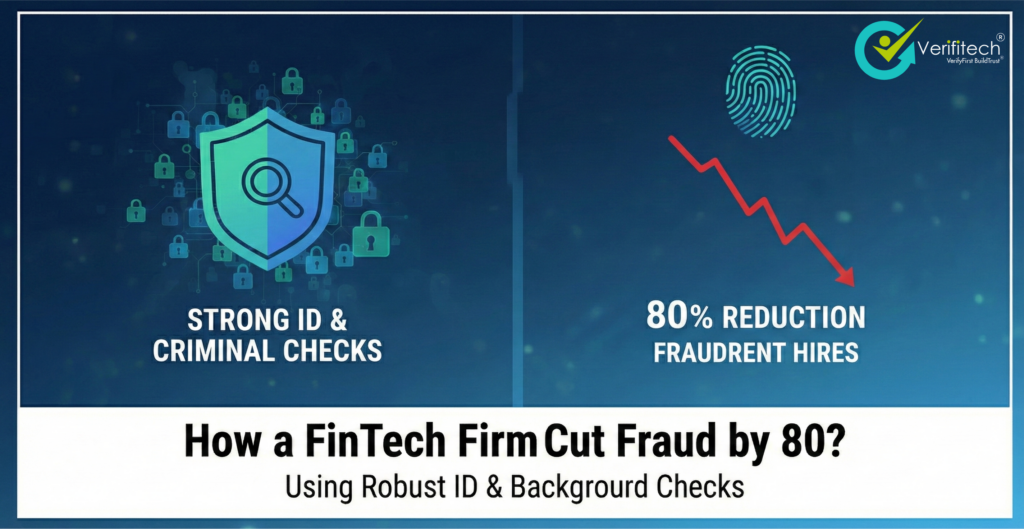
- 80% reduction in fraudulent hires
- 100% compliance adherence during regulatory audit
- Zero onboarding delays due to automation
- High employee confidence in security measures
- Complete criminal record check success, reducing organizational risk
These outcomes weren’t just operational wins—they restored leadership confidence, strengthened investor trust, and positioned the company as a compliance-first FinTech employer.
Throughout the project, keywords like fintech hiring fraud, ID verification results, and criminal record check success became internal metrics. This real-world transformation is what makes this an exceptional HR compliance case study for modern FinTech firms looking to fortify their hiring process.
5. Key Lessons for the Industry
This journey offered valuable takeaways for HR and Compliance teams:
- Identity verification must be multi-layered, not document-dependent.
- Automated criminal checks are critical to uncover hidden risks.
- Compliance isn’t optional—it’s a strategic defense mechanism.
- Data-driven hiring increases transparency and reduces human bias.
- Prevention is far cheaper than damage control in cases of fintech hiring fraud.
By embracing these principles, any organization can replicate the same ID verification results and secure their workforce against fraud.
Conclusion:
This HR compliance case study proves one thing: in FinTech, trust is the currency that matters most. With rising cases of fintech hiring fraud, companies can no longer rely on traditional verification methods. Strong identity validation and thorough criminal checks aren’t just procedural—they’re transformational.
For this FinTech firm, the combination of automated workflows, stringent ID verification, and global criminal screening led to remarkable outcomes: reliable ID verification results, consistent criminal record check success, and an 80% drop in fraudulent hiring attempts.
Any FinTech organization seeking to protect its people, processes, and reputation can achieve similar success by strengthening their verification framework today.